/
Talk
Roger O’Donnell / The Cure
September 15, 2026
Roger O'Donnell has been at the keys of one of the biggest and most influential bands on the planet for much of the last four decades (give or take a couple of breaks). Joining The Cure initially as a touring addition in 1987, he would become a full-time keyboardist for the band's next album, the seminal 1989 masterpiece Disintegration. A record beloved across pretty much every genre in existence. The Cure's most recent LP, 2024's Songs of a Lost World, was met with huge praise, topping album-of-the-year rankings and receiving nominations and awards aplenty (and becoming their first Swedish number one album!). Robert Smith and co. have continued playing their legendary, mammoth, hit-filled shows (for the uninitiated, there are many other stellar albums in their back catalog) in support of that recent release to much acclaim.
But that's only part of his story. Roger has also released a steady stream of excellent solo outings, covering both electronic and acoustic/orchestral directions. And prior to joining The Cure, he worked with an array of artists - from Arthur Brown to Thompson Twins to Psychedelic Furs.
We caught up with Roger ahead of The Cure's headline slot at Way Out West in Gothenburg to talk lots of gear and plenty more.
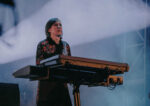
Let’s dive straight into the gear. How does the live rig you’re using today work?
I put it together quite a few years ago, and the heart of it is MainStage, the live version of Logic. I’ve used Logic for about 20 years, I think. I wanted to be able to run multiple instruments and multiple samplers, and MainStage was the perfect way to do it. When I started using it, it was still quite new. I know some of the developers there, and they helped me put it together, which was really useful.
Did you move to that from a fairly beefy hardware rig?
Not really. I never had a lot of synthesizers onstage. I generally had one mother keyboard and then a multitimbral synth on top. Originally, the idea was that if the rack went down, I could at least still make some sound using the top synth. But we’ve gone way beyond that now. I have a Kurzweil as the mother keyboard because I like a weighted keyboard. On top of that is a Yamaha Motif. I’m not even sure they make those anymore.
How has your rig changed over the last 40 years? Has it varied in size or components a lot?
Back when I first joined the band, we were using a lot of E-mu and Ensoniq samplers. We also had these sample readers, although I can’t remember who made them. The rig was big in those days. Then it got smaller, then bigger again, and now it’s very compact. I’m basically just running two Mac Minis in parallel. Some of the sounds come from the Kurzweil and some from the Motif, but most of them, including all the old samples, are in MainStage.
So the setup is pretty straightforward for your keyboard tech then?
Yes. I actually programmed it all before he came along. But he (Alan "Russ" Russell) now knows more about it than I do, which I don’t really like haha. I like to think I know what’s going on. It’s like when a plumber comes to your house and starts doing something, and you think, “Whoa, wait a minute!” Russ has reached the stage where he knows more about the system than I do. He’s made himself indispensable.
So you programmed all the songs in there with their individual patches?
Yes. We have about 120 songs programmed in MainStage, so we can just scroll through them and they’re all there.
The only thing that takes some time for me is remembering how everything is mapped across the keyboards. If we don’t get a chance to soundcheck, it can be difficult to remember where things are. Is the brass up there, or is it down here? Especially if there’s something we haven’t played for a while. It can take me a while.
That’s your live library. When you begin working on a part for a new song, do you use the live library at all?
No, I never take that system out of the live environment. My studio is all hardware synthesizers and electronic instruments. Some Elektron things as well. The Machinedrum is basically at the heart of everything. I discovered it through Jimmy Tamborello from The Postal Service. He told me about the Machinedrum and turned me on to it. I must have owned it for years now. How long has it been around?
The original with only drum synthesis came out in 2001.
Really? I think I got mine around 2007. I tend to write in two different areas. I write a lot of acoustic and orchestral music, and then I have my electronic side. I like both equally. When I’m writing electronic music, I usually start with either a sequence or a drum loop and build from there. Usually it’s a sequence, which is why Elektron equipment is so useful.
So you begin with a general feeling or vibe, start a sequence, and build from that?
Yes. Then I either build things up around it or take things away. Usually the sequence remains throughout the whole idea.
It will be some kind of looping melodic sequence. I find a sound, and that sound inspires me to do something else. Then the track develops from there.
How do you start the writing process on the other side of your solo catalog, the side based on acoustic instruments? Presumably it doesn’t start with a sequence?
No, although the processes are quite similar in a way. I’ve made two albums using only a Moog Voyager where I built the tracks one note at a time. I realized that this is actually very similar to writing for an orchestra, because each individual orchestral instrument is usually only playing one note: the cellos, violins, violas and so on. In that sense, the two approaches are quite closely related. With the acoustic and orchestral music, though, I usually start at the piano. My music is primarily emotional and that’s where it’s starting. Only secondarily technical. The most important thing is that I feel an emotion. If somebody else feels something from it, that’s a bonus. But my own relationship with the music is very emotional.
Listening to The Cure, I think that comes through clearly in your parts there as well, which leads me to a question about Disintegration. You were heavily involved in the soundscapes of that record. How do you look back at that period and the process of making it? Was it similar to the way you work today?
No. On that record, we very much played together as a band. We recorded keyboards, bass and drums together live, and then layered everything else on top afterward. As I was saying earlier, we were using a lot of E-mu equipment. I think we had just got an EIII. There was also a lot of Mirage and other very early sampling equipment. Looking back, we had a particular sonic palette, largely defined by Robert, and we kept everything within that palette. We would bring in our own demos, and most of the songs on the finished record ended up sounding quite similar to those demos. Then when it came to writing, it wasn’t always a case of creatively inventing all the parts together in the studio. For example, Simon wrote the music for "Lovesong". He wrote the organ part and the synthesizer parts, and I played them. I made the parts my own, and I made the sounds my own, but I was still playing his parts.
It sounds as though you were sitting in a lotus position somewhere, carefully shaping all the sounds.
It was a great experience. It was the first major record I had ever played on, and to be doing that with The Cure was extraordinary. It was also the first time The Cure had a dedicated keyboard player. I was very comfortable in that position, and Robert was comfortable having me there as a keyboard player because he didn’t have to worry about that area anymore.
When you compare Disintegration and Songs of a Lost World, more than 30 years apart, in what ways do they feel different?
When I listen to Disintegration now, it feels very stripped down compared to Songs of a Lost World. It feels sparse. The new record is much more orchestrated. There’s a lot more going on. I can hear Disintegration as a band. It feels like a band playing, whereas the new record sounds much more produced to me.
When The Cure works on music today, what does the process look like?
Robert sends me something and asks me to play on it. We don’t tend to use studios anymore. We work at home. He sends material to us, we play on it and send it back, and it goes backwards and forwards like that.
And those ideas from Robert, do you listen to them in headphones on walks while thinking about musical ideas for them?
Do you know what? I never use headphones. The only time I use them is onstage, where I have these in-ear monsters that I have to stick in my ears. I find headphones quite strange. For my most recent electronic record (2025's Projections), I also tried an Atmos mix. I went to Metropolis Studios in London, where they had something like 64 speakers in the room. It felt strange. It felt alien. I think electronic music lends itself to that kind of manipulation, but it still didn’t feel real to me. Afterward, I went to see my analog mastering engineer, and we mastered it in stereo. That immediately felt the way it was supposed to feel. Sometimes I listen in headphones to old records that I’ve always loved, and suddenly I think, “Wow, where did that sound come from?”
When it comes to new equipment and instruments, do you enjoy getting something new and exploring it?
Yes. I love plugging in new equipment. It’s great because you can get things out of it that you wouldn’t otherwise have discovered. That’s especially true when you work with the kind of inspirational approach to music I described earlier. You plug in a sequencer, let it run, and it takes you to places you didn’t know you could go. I love getting new gear. A new instrument can inspire something new immediately. It’s almost like receiving input from another musician. The people who build the equipment put their own feelings and ideas into it, and that comes across immediately. That’s why I think it’s important to remain independent. Many of the larger companies have been bought up. Dave Smith sold Sequential, and Moog has gone the same way. In my opinion, those companies don’t make the same kind of equipment anymore. Obviously it still has to sell, but there needs to be passion in it. Dave remained inspired throughout his life, though. He was always searching for new sounds. I once met his wife at the NAMM Show in Los Angeles. She said to me, “Dave is always down in the basement making all these horrible sounds. I don’t know what he’s doing down there.” And I was thinking, “He’s creating these incredible instruments!”
One final question: Desert-island equipment. What would you bring?
My grand piano. If I can also have a tuning wrench with me...
Photo by Aaron Law