/
Talk
Merde
August 25, 2026
We spoke with Gothenburg artist Merde about the downtown graffiti temple he built over a period of two years. He discusses why and how it came to exist, and touches on the future of a place he calls The Cave.
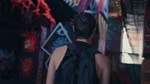
What's your name, and where are we?
So my name — my tag — is Merde, and we're in a temple, downtown in Old Town, in Gothenburg.
What is this place, and why did it come to exist?
It's a good question — why. But I guess it was a way for me, in some ways, to process things. And to do my own thing, at the end of the day. Like — how do you say — just for myself. Playing with my time.
I've read it being described as a graffiti temple.
Yeah, you can call it a graffiti temple. I don't see it as graffiti so much. But it's done with spray cans, so it's immediately put in the graffiti box. But, for me, coming from a classical graffiti background, people in graffiti are pretty hard to say graffiti is just letters. Writing a tag. From that definition you maybe can't call this graffiti, but the wording doesn't mean so much for me. You can call it a graffiti temple if you want.
I also saw that you described this space as a protest — a peaceful protest. Those are interesting ways to describe it. If it is a temple, what is it a temple to? And if it's a protest, what is it protesting against? And what place do honouring and protesting have in art, in general?
Absolutely. I think that's the artist's job in a society — to question power, to question power structures. And also nowadays with surveillance, advertisements everywhere — everything has a price. Most places where you meet up are just about consumption. So it's a protest against that. A bit like an anti-capitalistic room that someone did just because they like to create.
And also — me personally, I think it's pretty dystopian times right now. With the media and everything, these narratives about all the wars. It takes a pretty big toll on me personally. This climate in society right now. So you can call it a protest against that. Or my own way of doing my own thing, away from all that noise.
The name - for the exhibition became Apocalypse Right Now for the art show.
It's a reference to the time we're living in. It's almost more precise right now than when I made this — with the war in Iran, the genocide in Palestine and Lebanon, Epstein - everything. So that became the name.
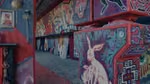
Obviously it's in Gamlestan — one of Gothenburg's oldest parts. Was that a coincidence, or did you just find the space and it happened to be here? Because to me it's interesting — there's this contrast of a really old part of the city and this contemporary art being created here.
It was basically the spot that made it. I found it and this was perfect to do something, and I live close by — so the stars aligned.
But this is a special thing - this spot, because you have people all around. It's right under the feet of train-goers and trams, and also the new skyscrapers. And this is a part of Gothenburg where gentrification is going pretty hard — you have the big companies above. So I think it's a nice contrast to have this here. It's almost like the unconscious of the town above. Or like the lungs of the station.
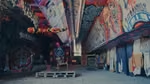
It's such a great location. It reminds me — I've seen you talk about it about it being like a church space, and it really does feel like that. The dynamics of the room very much feel like a nave — that long part of a church that leads up towards the altar. And churches often feel like a relic from the past in the middle of a modern city. You go to London and other big European capitals, and you find these really old churches, a thousand years old, with skyscrapers around them. This feels like a little Gothenburg inversion of that.
Yeah. And it's also like this brutalist structure — this big thing in the roof (pointing to a concrete beam) coming down. I always liked this kind of brutalist structure. It's almost a shame to put paint on it (laughing).
Also beautiful though. It's a great contrast with these sculptures, full of Gothic influence.
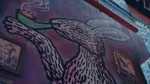
These ones I thought first: do a bit of a gargoyle style. And then basically the sculptures I made after looking at the spots already here. Like the dogs up there — it just felt right away: we have to have the gargoyle style there. And up there (pointing), I was thinking — maybe I can have a dragon there. With the Jesus also — I did the sculptures thinking about the spot, like what could look cool there. It's basically the same as regular graffiti — you have to design the painting from the spot.
I hadn't even noticed Jesus up there!
The children call him Spider-Man. He's hanging upside down.
It becoming a church space and having an altar, was that something you had in mind when you started?
It was a bit, yeah. It was one of my first ideas — to have some kind of altar down here. For the people who live at the edges of society, a bit. A different kind of altar.
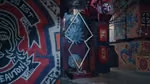
If there's an altar, who or what is its god?
It's a good question. Me personally — I'm not into just one religion. It's more like spirituality. So I think it's up for each person — each man their own. Some people have thought it was Satanist, but it's not, from my part. At all. I don't fuck around with the devil (laughing).
Was this entirely your creation, or did you get help from people?
I was mostly here alone. I had one friend who did this painting here — one of my best friends. But I got a lot of help for the exhibition. Mainly this guy here — Push — an old graffiti friend who helped a lot. To make this (the exhibition) happen, I had a lot of friends helping me. Otherwise it wouldn't have been possible.
Another big shout out to Dome — a graffiti artist from Gothenburg, old head, who painted a lot down here before me. You can see some of his painting a bit further down.
I'm sure it's taken a long time to put together — and yet as you go through the stages of creating new art and adding sculptures, the dynamic changes with where we are in the world right now. How long did it take you, from starting to getting here?
It took about one and a half years. During the winter I had a break for about three months from being down here, because it's not so cosy here in winter. During that time I was here maybe three times a week, a few hours, and did one painting and then another. So it came one painting at a time. The sculptures I did at home and carried down.
Whereabouts did you start?
We can walk around a bit. Because this painting over here — it was my first one, the Merde piece. That one I did when I was still painting traditional graffiti — letter-based, and also in town. Like when I lived the graff life more.
Then I had a pretty rough year. I broke my leg — crushed my leg really bad. And after that experience, I went through like an inner journey and I changed some things in my life. So I went away from classical graffiti, being out at night and all that, and chilled down a bit.
And then I came here, like a year after that experience, I saw this place in a different light. Like — you don't have to paint regular letter-based graffiti. You can paint characters and stuff with the same energy. And I got this sacral vibe from this place, with the roof and the structures.
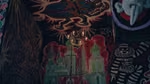
So just to start, I did this Santa Muerte here. It was the first one I did. And I thought — I'm going to paint more characters in this area and do it with a bit of a chapel vibe. And I started doing these sculptures. It's the seven sins, because I wanted a different vibe than regular graffiti. If someone comes in here, I want them to have a different energy.
And then it grew. So over there, I felt this is like an altar, and I did that. Then in the room, and then I expanded out here. So there wasn't really anything planned to start with. I started in one direction, and then it grew.
How does this place handle the weather?
There are pipes down from above, from the station.
When I had this exhibition, it was in October. It rained a lot before and I was thinking — this is going to be like the First World War. Really, really trench mud. So I was climbing up here in the roof and putting pipes on the pipes, and leading the water down into this big ditch. The two weeks before I was down here pulling away the water so we could have a dry floor. But otherwise it's pretty weatherproof. It keeps the wind out for the most part.

How you work - would you say you're more like a freeform jazz musician, or that you're carefully composing — when you come down here and were painting the walls?
That's a good question. I think I'm a bit of both, really. Usually I'm pretty much a perfectionist — when I paint a canvas or something. And also when I paint graffiti, pretty planned before. But here you can't be a perfectionist. It was more about creating an energy than every painting or sculpture having to be perfect. So it was much more freestyling — just go with the flow. Some things I had an idea for and thought out, but most paintings just came up on the spot.
Can we talk a little about the materials you use? Is it spray paint, other materials, a mixture of the two?
It's mostly spray paint. Absolutely. But roller paint also. I rolled before I spray painted — fresh concrete is really nice to paint on, but it sucks up a lot of colour. So if you roll it first you can use less spray paint and it's cheaper. The sculptures I made mainly from shit I found down here — it was like a garbage dump when I found this place. Some of the stuff for the sculptures I also got from my work, getting hold of foam. It's very easy to work with — you can just cut it with a bread knife.
What inspires you to start a new project? What would you say are your major influences — any kind of art form: music, film, literature?
I think it's literature mostly. What I read at the time comes out through the paintings and sculptures. And old art — old Egyptian, old Hindu paintings. That kind of stuff. I think it's really cool.
I listened to lots and lots of audiobooks when I painted this. One ear on the audiobook, the other ear alert for sounds from outside. I listened to many books down here. And music, a bit the past few years I haven't listened to as much music as I did earlier in my life. But I listened to some — like Orthodox chanting, Siberian monks. It was nice down here.
There's obviously a lot of symbolism and cultural references from all kinds of periods of history — mythical, ancient, more contemporary. How did they come to be connected here?
I think that's like the red line through this art — humanity through space and time, through the ages. It's the same stuff we struggle with now, basically. Humanity across space and time, and our relationship with higher powers and ourselves. Like — that over there, it's the Epic of Gilgamesh. It's just a mosaic of different references.
There are a lot of Latin phrases as well.
Quo vadis. It's biblical. It means "where are you going?" And non serviam — "I will not serve." It's also biblical, but they used it in Rome as an anti-establishment statement. It's a lot of profound reflections. And a lot of references to some of my favourite movies and books. Like A Clockwork Orange underneath this figure here — Kali, the destroyer and creator. So it's a bit of chaos in here - And I had a lot of orange spray paint. You take what you have and do the best of it.
The longer you spend here, the more small things you notice. The exhibition feels like it's pouring out in places.
I was sitting up here (pointing to a raised section) a lot during the time I was painting. Having a folk beer or something, watching all the people walking under. Nobody's looking up. So you're in the middle of everything and it's a nice feeling.
Being close but far away at the same time.
No one's ever seen me up here (pointing to a ledge) — maybe one or two times. But I've been sitting here a lot. People are so caught up in their everyday life — they don't look where they don't think they'll see something.
Did you bring a lunchbox when you made stuff here.
Yep a lunchbox and a drinks cooler. During the summer, long days, sometimes I just painted in my underwear. It was hot, you know — when you work with the cans you get dirty. So yeah. I ran around here in my underwear.
What was the toughest piece to realise?
When you paint on the roofs — you have to run up and down the ladder all the time, and the spray cans aren't built for spraying at that angle. So it was more taxing to paint the roof.
But this statue — Kali — it was just a guy who came into my work and gave it to us. He had it at home. A mannequin. I said sure, we can have it here, I'll do something with it. And I put Kali on it. She has the Kalashnikovs on her side and the Celtic tree of life.
How did you reach a point where you felt it was finished?
It was a pretty hectic time, because I have a girlfriend, and I study, and I work. The last two months I was very tired. So I looked forward to putting a dot on this. But it just became — I wanted to do it all the way out to that point (the entrance), so we'd have a good entrance and it felt like you could finish in a classy way.
The graffiti scene in Gothenburg — what it's like, has it changed over the years?
Yeah, I think we have a good graffiti scene here in Gothenburg. It's not so big, but it's pretty tight. We have a lot of younger people who are really good, and the same old heads doing their thing as usual. But we don't have a metro and that kind of stuff — like the bigger cities. But we have trams.
Why do you think art — and specifically graffiti — is considered by some parts of society something to oppress or remove, and by many others not just as art but as something worthy of appreciation?
Here in Sweden we've had zero tolerance for many years. Basically within 24 hours it's got to be cleaned away. That's a pretty aggressive stance against an art form. But it's about control.
What role does experimentation play in your creative process?
I think here, when I did this project, it played a big role. Because I wasn't used to painting characters so much with spray cans — I mostly painted letters before, in a different way. This is much more about details. So during the process it was a lot of experimentation with different cans and techniques. It played a big role.
Getting stuck creatively — not sure if that's something you've experienced here or in general — but when you get stuck in a rut, or you have a goal but not the route to achieve it, what kind of medicine do you use to get unstuck?
I think it can be good sometimes to have a pause. Look away, do something else, and then come back and look at it with different eyes. Basically — if you're stuck somewhere with a painting, you can just start a new painting and then come back. And I was so fortunate to have this whole place as my own private atelier. I could leave something and come back. It was a work in progress all the time, and nobody came and messed with it. Basically almost too good to be true — to work at a place like this for one and a half years without being shut down.
What's the strangest thing that's happened while you've been down here?
I haven't met so many people down here. I mean, if this were some other city I think there would be a lot of people living here — you could basically build a favela down here. But not so much weird stuff, actually. It's been pretty cool the whole time.
I had one entrance on the other side also. Like a rabbit — you have two entrances. If they come from one side, you run the other way. So I didn't get busted.
What is the future for it?
It's a bit funny — we talked about it before. When I started doing this, it was like I took a step away from the outside, from people. And now it's the opposite. I come here and meet you guys, and people are interested.
But — Trafikverket (the Swedish Transport Administration responsible for the operation and maintaintenance of state-owned roads and railways) has said they want to demolish this in August. But Gothenburg Art Hall and Kulturförvaltningen (the regional administrative body that manages public libraries, museums, art halls, cultural centers, and public art grants on behalf of a local government), some others are proposing to keep it, and maybe do something more "white" with it. We've had some suggestions — like during the book fair, have a poet read their poems here. And during Kulturnatta, have a live performance.
And, are you sure you're finished?
No, not sure. If this will still be here, I will most definitely continue in some way — but not at the same intensity as before.
Check out “Close, but Far Away”, the slow-TV meander through Merde’s magnificent space of creativity – accompanied by an ambient liveset from Elin Piel with Tonverk.