/
Talk
Author and Punisher
March 1, 2016
Meet Tristan Shone: Author & Punisher. The artist, who realizes, if the instrument or device he needs does not yet exist in the realm of our senses, just head straight to the mech workshop and build it. To a sturdiness, accuracy and tightness of tolerance that would put Stanley to shame. The musical devices he makes don't just look awesome, they work beautifully and can take a beating, too.

There is a sort of inverted, Ballardian logic in your music, in that it's frightening and inviting at the same time. In Ballard's world, the atom bomb was, and is, a positive force. How do you feel?
Well, I should say I'm a total pacifist. Unlike some Americans, I very much use my music as a sort of release for any sort of anxieties that I have, whether they be personal or political. My music may sound apocalyptic, but for me, if anything, it's a positive emotional state that I put myself in. I think it's a good release.
What inspired you to start building and modifying your own electronic equipment? Is that something everyone learns in school all across California?
(Laughs) I went to undergrad - my main engineering studies - in the East Coast, and I did go work in industry first, before I decided to go back to art school. That's really where it started, in deciding to go to California. It was a slightly more relaxed atmosphere than the East Coast.
The weather's nice, it's all living outside and, for me, it was a chance to try how I wanted to make music, to come up with more innovative ways to combine art and engineering. Getting away from sequencers and midi-controllers was part of my artistic process, to try to express myself more clearly.
The setting was obviously very important in order to make your mechanical and electrical DIY-dreams come true?
Yeah, the environment of Art school. Using technology for art and to develop technology, not just for musicians but other artists, like sculpture artists, as well. I needed to be in a creative atmosphere rather than in a research atmosphere. If I was in a research atmosphere, like maybe the MIT Media Lab, or one of these more money-driven labs, I might be forced to work on a project that is not my own personal quirky project.
So for me, to be able to say *you can do whatever you want *was really important. I did some terrible projects, when I look back on them, but I wouldn't have been able to build drone machines if I hadn't gone through that process.
Can you say roughly that the East Coast is more theoretical, while the West Coast is more pragmatic and creative, in a sense?
I don't think so. I mentioned MIT, and people have done amazing things there. It's just that at that time - it wasn't right for me. I wouldn't say that's the difference, because certainly there's also a lot of theoretical activities in California, the Jet Propulsion Laboratory for example, Berkeley, CCRMA, the electronic music department at Stanford, and so on.
No, I just think it's because the atmosphere is more relaxed. I started surfing a lot when I was out there, working from a place of reflection and calm rather than anxiety, and it just doesn't rain as much. The weather's better.
Why do you think that is, the fact that the microcomputer as well as the synthesizer sprung out of California? Is it due to a sort of DIY culture built into society?
I don't know. I mean, it *is* creative. My wife's family is from Silicon Valley. If you go up to San Francisco and Silicon Valley, that's much more north than where I am, you sense a creative atmosphere everywhere you go. From the craft beer culture, and the food, the outdoor activities, to the innovation in some of the small companies.
People make fun of people doing Yoga, you know, and drinking juice and working on music, but there is just something about it. It's a beautiful place to be.
You mentioned craft beer - is there a favorite?
Well, I'm from southern California, San Diego, and we do like to pride ourselves on the IPA. So, I would say - although they just got purchased by a huge conglomerate - Ballast Point's *Sculpin* IPA. It's probably the best we have to offer. It's right around the corner from my studio. I'm not going to say that's a good thing!
What is the single most useful piece of kit that you've made? The one you're most proud of?
I would definitely say it's the one that started out as the Linear Actuator, but is now called *Rails*. It's my drum machine controller. It's extremely robust, I've never had to make any changes mechanically, or any re-wiring or replacing a button or anything. It basically controls drums, it slides back and forth, and it's just been rock solid. Other than that, I'd say my foot pedal. When I first tried to change settings with MIDI on my computer, I wanted to buy a foot pedal that you can just map to things. It's very hard to find one that's just a blank slate. I don't like a lot of parameters or menus. I just want things to be like, if it's a knob, it's a knob, if it's a button, it's a button. I don't want anything else.
Rails and Pedal was my second round of machines. The first set that I made, the drone machines, were much heavier. It was very much a sculpture project. A sound installation. They weren't really intended to tour with, although I've toured a lot with them lately. It's brutal on my body. I have to take a break from them. I do three shows and then take a break. The second round, the dub machines, tended to be lighter, designed around flying to places. Lighter, more transportable sets of machines.
Your standard large hardware tool company, making a purely mechanical device with fewer moving parts than your electromechanical devices and with similar tolerances as your Rails, usually needs three years from conception to production. How long did it take you to make your devices?
The nice thing about my devices, compared to the devices I work on at my job, which is electron microscopy at the university, is that people's lives aren't depending on the tolerances of them. You can get away with little accidents, and it will still feel the same and it will still work the same. It's just as simple as, for instance, not being able to find the right size metal for a part. At work, you'd spend thousands more just to get exactly what you need, but for my devices, I can go to scrap yards and change the design based on what I find.
Right now, I have a new drum controller that I'm designing. I've been designing it for two years, but it will probably take me a few more months this summer to build it.
Some of the mechanical devices you've built seem sturdy enough to survive the bombing of Dresden all over again. Your mechanical workshop must be the most solidly equipped in San Diego.
To tell you the truth, we do have a workshop, but it's not mine. It's a shared workshop, and I have one machine there. I've had more, but I buy and sell them. I use all sorts of machine shops. I work at the University of California, San Diego, and I end up sort of camping out in other people's workshops, for the most part! I have enough sound gear, I try not to have that much stuff, you know?
I'm learning more about fabrication, and trying to have a lot of it pre-fab'd, whereas in the past, I would machine everything myself. Now I'm learning ways to machine the parts that are hard, and then do the things that are easy on my side.
The devices you make, apart from making sure they work properly, I guess you also try to make them portable and that you're able to pack them conveniently?
That's been, actually, the biggest difficulty over the years, and probably why I haven't built new stuff for a while. Touring has been rigorous, and you know, as much as it's frustrating as an artist, you see new artists saying things, after a few shows, like: Okay, I'm ready to go do something new, now. I think, when you're in the music world, that doesn't exist. You have to tour extensively in order to get people's attention.
Repetition has been the biggest issue for me. So, redesigning devices based completely around how roadworthy they are has been a huge deal. On this trip, for example, I need battery back-up for sound cards. If your computer battery dies, or the plug gets unplugged, you're ok, but with your sound card, if there's any blip in power, you're totally screwed. You have to restart the computer in order to reconnect to the sound card. $600 battery back-up. That's my newest thing I have to buy. Things like that.
To what extent do you draw inspiration from non-academic sources when you design your electromech devices?
Totally. I would say I'm hugely affected by film. Although, not so much fantasy, I would say. More lyrical and abstract stuff, and people like Lars von Trier and Bergman, my heroes of this area. Also, some sculpture artists that I know in the US, who have influenced me a lot. Some that I know directly that have helped me learn how to build large metallic sculpture, and also on the electronic side.
A lot of people assume that I'm more into science fiction, but I'm more kind of old-fashioned, more inspired by the devices of the industrial revolution, the really simple devices, rather than the super hi-tech.
Do you have a historical mechanical hero, like Archimedes, the Banu Musa Bros or, well, Hero?
You might catch me off guard with that one. Let me get back to you on that.
When you read Newton's Opticks, it's endearing how open-minded, non-arrogant and inviting it is. For example, he keeps the particle/wave duality of light an open question. Much later, other people decided that he chose sides.
Reminds me of back in school, 20 years ago. Yeah, I do think there's an arrogance to engineers and scientists that can be off-putting. You know, luckily now, with DIY-culture, it can be a little bit more ubiquitous and I think we can put some of those voices to rest.
I work with a lot of physicists, and they may have sound studios, or home bike repair shops, and they think they know everything! When they're around my musical instruments, they want to tell me exactly what I've done wrong, you know? I think the reason I got into art was because no one could tell me that, and I could make those mistakes and experiment. I think a lot of the, probably the machines you guys make, or guitar amps and things like that, were an accident. I think screwing up is a good thing.
Yeah. That's also why it's refreshing to read some of the older sources, where the cook-books for physics weren't really complete, like they are today in a lot of ways. Did you ever, when you made one of your devices, come across anything that sort of contradicts what we know?
Yeah, for example, on the first album. I didn't know much about MIDI, I look at the way I do my set now, and the way I used to do my set, I would never have done it that way. Programming MIDI, for example, I would do things like set up a WHILE loop to send MIDI. Instead of having a note on, for example, I would have a note on/note off with a two-microsecond delay or something. So I was actually triggering a software synth at an extremely high rate. I was creating like a sawtooth wave rather than just triggering and starting the software synth.
I would create these heavy, mechanical sounds that no-one was making with that soft synth, because you could use the Arduino and you could do things with your fingers that you couldn't do otherwise. You're not going to buy a MIDI-controller that's going to cycle a MIDI note like that, you know? I feel like you could program in some really cool, gabba, super high-speed - you hear about these guys doing 1000 BPM industrial music - anyway, that was a nice accident, because it made a sound that was like: *How did you do that sound?* Of course, I don't do it now, because it crashes my computer most of the time.
You built a waveform generator out of stuff that wasn't supposed to do that! Is that a driving force for you, to use stuff in ways they're not intended to be used?
Well, I try to get to the actual composing of music as quickly as I can, rather than geeking out too much. It's one of the reasons I don't buy a lot of hardware, because I'm worried that I'm going to get stuck learning how to use a menu rather than playing music. I think this is the problem with a lot of electronic musicians. They spend so much time in manuals rather than actually being a musician, you know? Even I worry about it, now, because it takes so long to set up my gear! I can't sit and write a song in a hotel room, a lot of times. I've been trying to get back to the piano, recently, so I can write music more easily.
Have you ever pitted an electronic drone machine against a mechanical one, like the Hungarian Hurdy Gurdy?
No, but I've found some recently, that are still in the machine shop, that are pretty vicious. These are more like machine tools that you can create amazing sounds with. I haven't loved the sound of mixing the acoustic with the electronic.
Do you think there will ever be a time when we can jettison all non-digital equipment?
I don't think we'll ever do it. Even though it's not for me, well, I like the piano, but I just think that there's something, a tonality that's missing, with just the purely electronic music, something purely organic, that people just would not get.
What do you think is the next step in terms of breakthrough musical technology?
For me, not in the music technology but in the fabrication technology, the fact that fabrication technology has become much cheaper and, you know, being able to take an old manual mill or lathe, and make it into a CNC has become easier than ever before. You don't need to buy a $5000 kit, you can do it for $1200 now.
For me, that's where the difference is. You can make the parts yourself instead of having to spend tons of money. Also, the CAD software, being able to design things more intuitively rather than having to use these really complex AutoCAD line-based programs.
What software do you use?
I use SolidWorks most of the time. That's the easiest for me.
In your compositions, it is as if there is a grinding, a struggle between the physical and the digital. Have you started using the milling, grinding and bleeding of analog and digital that is Elektron Overbridge, yet?
I have, yeah. I've hooked it up to Ableton, and it works like any other VST, and there doesn't seem to be any latency. I'm going to try to hook it up to the rest of my gear, and I'm excited to see how that works.
The prankster, usually in the form of an animal, was a crucial part of all pre-Christian belief systems. Can you share a memorable prank that you have been part of, in any way?
Hooking my machines up to whistle sounds. That was a pretty fun performance, exactly what you don't expect to hear from me. I let my video guy program my machines, because he was a student when I was teaching a little bit, and he changed all my sounds into these super goofball sounds. I was annoyed!
Any record of that, still?
No, I tried to get rid of it as quickly as possible. Another one I was involved in was, when I was in Catholic school, I would constantly wear shirts referring to how much I loved Jesus. That didn't go over very well. Being the atheist that I am, I guess I was a little bit ironic.
What role do the Elektron machines play in your set?
Something I've been striving for, lately, is getting my sound out of digital - and I don't necessarily know the difference, yet, really know the tangible difference between digital and analog, you know? For me, it's like, you hear about it, but how many people *really* know? You guys know, probably, because you hear this every day, but some of us who've been using software, or gone from guitar - I use guitar a lot - and then gone into this world of Ableton and Native Instruments and Reason and things like this.
I've started taking some of my tones and putting them on my guitar amp, tube pre-amps and things like that, take my vocals through some analog, rather than having everything digital, through Ableton. That's where the Elektrons come into play. Get a little more punch out of the kick drums.
Where do you get your tubes?
I'm more referring to something like Verellen, an amp company based out of Tacoma or Seattle. They make a little tube pre-amp. Just take a tone, run it through there, run it into an amp that has no crossovers, not a PA system but a speaker, and just kind of hear what that sounds like. Not a home-made tube. I am not going to build analog devices, ever. I can just tell you right now. Other people are doing a much better job than I'll ever do (laughs)! There are a couple of electronic stores in San Diego that I know really well. I can go into these stores and I'm always having to buy various military knobs and levers and things like that. From an ideas perspective, I always buy new microphones to use as input devices, and it's always kind of fun to hear what these microphones sound like, and what these old amplifiers sound like.
There's a film just out, American Epic Sessions, where someone has rebuilt 1920's recording technology, got the original Western Electric condenser microphone working, and uses it all to make new recordings of artists like NAS. Who introduced you to Elektron instruments?
That would be my friend Jason Begin. He goes by the name of Vytear. You should look him up, he's an old hat electronic musician, in the vein of Venetian Snares, or Aphex Twin. He's played with these a fair amount. He just started using them, and before I knew it he had four on his setup! He would be playing them all live, and it was pretty amazing what he was doing with them. He's one of those sequencer geniuses, you know.
Your first name suggests your parents had a penchant for literature, mythology and the classics?
My mom is - I'm not suggesting you do this - if you go on to her Goodreads-page, she's got thousands of books there. Believe it or not, there are several different sources. Yes, there's the opera. There is a show on British television called *All Creatures Great and Small* by James Herriot, a veterinary show. There was a character on there, Tristan. Then there was another great book called *Black Rose*, and there was an archer named Tristan in there.
Something fundamental is evoked when you witness an Author & Punisher performance. Your music speaks your spine and gut as much as to the ear and brain. Heavy and captivating. From what do you draw inspiration to be able to relay stuff of this gravity and impact? Other musicians? Philosophy? Nature itself?
I think, starting out when I was playing piano, because I didn't grow up with heavier music until I was, maybe when I was sixteen. I didn't know about Black Sabbath, because I lived in a really small town. So I would just bang on the piano. I was taking lessons, but I would just bang, you know, making these kind of drones, finding these tonalities. Then I heard The Melvins. They did an album called *Lysol*, which they had to rename because I think Lysol sued them. Anyway, there was a track on there that was more than ten minutes long. Very tribal sounding, droney, very heavy, it kind of built in this way and I really enjoyed it. I think, from there on, it was just something about song structure and repetition that kind of got on my nerves a little bit, and I really wanted to feel more.
Also, seeing really epic, deep films, you know, really dark, don't make me depressed. They kind of inspire me. I don't mean that in a way that I'm some sick serial killer, I just mean that there's something, when things are really serious and can turn for the worst, there's only one way up, you know what I mean? That's why, when I see films by Lars von Trier, I tend to see the comedy in it. I think he thinks they're kind of funny, too, because they're so, there's nowhere to go but up from there, and I think some people live lives like that. Of course, I don't. I've had a nice childhood. I love my parents and I love my family!
Do you explore the drones found in the natural world at all, like howling rock formations, the purring of cats, stridulating cicadas?
Yes. I love the desert. The southwest of the US. It's a pretty lonely place, but I love it. There's that constant drone there, and the sound of wind. The peacefulness of it. But also, I like surfing. I don't like surfing because I'm good at it, or because I think it's an aggressive sport or for the thrill of it. I do it for the peace of it. It's one of the same reasons why I make music, you know. It's a very peaceful thing. When I'm coming up with new sounds in the next few days, a lot of it is going to have to do with just simple tonalities, and where sounds cross over, rather than something that I think is catchy. When I'm practicing in my studio, I can never just write stuff with my headphones on. I have to have the full sound system that I've built at home. Home-made subwoofers and many different speakers, and I have to have it loud. I think that's why it translates well through a PA system when I play live. If it's a good system. Because I always play things loud.
You know how it is when you do things with your headphones on. You don't feel that in your gut. I was doing drum machines with Reason, back in the Reason days, Reason, along with guitar, I would start playing the Reason set as a backing track for my guitar and I just knew, because I wasn't playing it live, that it did not have that live power that I wanted. Even to this day, when I run sequences, it doesn't have that power. When I try to do it sometimes, my wife will come tell me after the show: You shouldn't have played those sequences. Right when you did that, it just lost that magic that only a live performance has. That's not to say for *electronic* music, it's just for *my* music. There is a lot of amazing electronic music that is supposed to be that way, and I love that, and it's a huge influence on me. I'm not saying everyone should play live techno beats. That would be terrible (laughs). If I were to constantly hit the thing repetitively. I'm not saying that everyone should do that, because I've also seen people do that, and that just seems like it's a redundant or unnecessary thing.
I've got to ask: The harrowing string glissando sound throughout the beautiful song Below and Above You, how did you create that?
I can't completely remember. When I first started using my headgear microphone, one of the things I wanted to do with it was to be able to breathe, blow into it and use the blowing effect to control some sort of strings. The idea of blowing, have it sound like wind, but also having it sound like it was strings.
I was in a hotel room in Brazil, had a show, and I needed to write a song for the show. I found some Ableton vocoder that I put through some reverb... It wasn't anything but the blowing, you know, using the headgear as a MIDI controller and also as a microphone, mixing the two.
Also, same song, the crackly, alive, staticky drone, was that a drone machine of yours?
That's a drone machine, yeah. Rack and pinion. Just a simple pitch bend controller. That's been the sound that, I guess, has been the most noticeable in what I do. I try to always have tones or controllers that don't hit pitches exactly. You're always kind of a little off.
Makes it sound a little bit like the mechanical Hurdy Gurdy?
I just saw the singer for the band Amenra, he uses a Hurdy Gurdy for his new solo project. You should check it out, it's called CHVE.
Sounds almost like the Hebrew God. Or perhaps the cepacious vegetable? Anyway, I'll check it out. I know that when you assume, you make an ASS of U and ME, yet I'd like you to comment on the fact that, throughout your five albums, there is a progression, a sort of Virgil ascent from the dark and gritty underworld, striving, album by album, successively higher and towards more melody, more harmony, perhaps toward a transmission or channel of communication between the nether and the above?
Perhaps it's just me getting older, and also touring a lot more, seeing a lot more, being more aware of what I like and what I like to hear, but I've definitely been moving away from the really just vicious wall of abusive noise. I try to make it so that if it's loud, it's also beautiful, you know. Not beautiful, but it has something pleasant about it. I try not to be the guy who's just up there screaming and being brutal.
Lately, I've tried to play some older songs, to have them live, because sometimes people want to hear them, and I realized I was doing it not for myself, and I found I didn't enjoy it. Not because it was too brutal, rather, I just feel I've done something nicer lately. I can make it heavy but also give it a lighter edge. Why go back?
Interview by Daniel Sterner
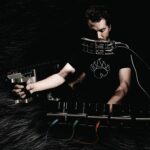
Photo by Johan Melin