/
Talk
Warpaint
May 22, 2014
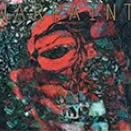
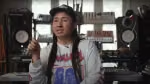
Warpaint is the best thing to come out of California since Orange Julius (a divine beverage made of freshly squeezed oranges and a knife's tip of secret ingredients). This year is truly the year of Warpaint. Their signature album Warpaint, produced by Flood, was released. They have been touring relentlessly, played at Glastonbury, shared a stage with Nick Cave & The Bad Seeds. They've been on Conan. Meet their key member, the powerfully austere, and loudly quiet, guitarist and keyboardist Emily Kokal.

How did you first get into synthesizers?
I started playing piano when I was four. I always played piano when I was younger but when I started playing in bands I began playing guitar. Rock and roll. I think the first synth that we had was a Kurzweil. We had a few 80's synths as well and I loved it! It was like playing the piano when I was younger but all of a sudden you had these amazing sounds. It was really exciting, and something I realized had a great love for. So I started playing that. I think we had a Nord as well.
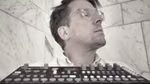
When I was going out with John Frusciante (featured in this Elektron Talk) he really introduced me to all things synthesizer. He had a bunch of modular synthesizers, a Doepfer, a Mellotron. He got me a Sequential Circuits Prelude, a really old eighties synth which I loved. It has a really cool sound. I play it a bunch on the new album, it's the keys in the song Drive. I also play around with the Prophet a little bit, and I use a Korg MS-20. Those are fun, but I still have the desire to get more prolific in patching. I love the idea of messing with frequencies that are already alive. It's an amazing concept. It takes music into your private space and allows you to capture the current of the moment. My boyfriend has a Machinedrum which he really loves. I went to visit Elektron in downtown Los Angeles to check out the Analog Keys. I was so excited! I love electronic music so much. How could I not get into this? But I realized the Keys was going to be the most complex of all of my synthesizers.
Are you a classically trained musician?
No, I'm a play by ear person. At a very young age, I had a really good ear and I was able to pick things up and teach myself playing. I'm actually very limited in the classically trained kind of sense. But I like to learn things and play by ear to make my own world! I love electronic music and classical music. There is an element in classical music that spreads into electronic music. That really speaks to me. I love artists like Aphex Twin or Jon Hopkins who make beautiful melodies and moods that really feel like classical pieces.
I come from a household of musical people. My brother, mom and I would all get together on holidays, singing and harmonizing. I sometimes would get so excited that I'd throw up, just thinking about my grandmother's hot chocolate and sugar toast. We'd all go to my grandmothers house, all my uncles and my mom and everybody would get together to sing and celebrate. I think we are a celebratory people. We like to celebrate whenever there is a chance.
Surely, Exquisite Corpse is a hail to that morose British boyband of the early eighties?
It's funny because Jen (Jenny Lee Lindberg) has that background, The Cure, Bauhaus and all that stuff. A lot of it appeals to me, things like guitar lines and choruses, but before being in the band and before meeting Jen I hadn't really listened to any of it. She thought I played guitar like Bernard Sumner a little bit and I didn't really know who that was!
It’s like you are planting a seed of late seventies goth romantic Britain in the heart of modern-day LA. Would it piss you off if I described your sound as unamerican?
When you say that our sound is unamerican - we do have a sound that sounds like it's from another place but there's also something quite American. Well, maybe not American but there is certainly a bit of West Coast progression that comes into our music. I'm born and raised in California and Oregon, Theresa (Wayman) is from Oregon, we're from the West Coast and I think it seeps into our music a lot.
Where does the name Warpaint come from?
When we started the band in 2004 we didn't have a band name for ages. Well, we had a lot of names and we kept changing it, but the band didn't really come together until we had the name. When I thought of the name, it seemed really strong, almost intimidating. Having the word war anywhere near our music conjured up a lot of thoughts and a lot of feelings. War is a really intense word. Warpaint has a lot of power to it, and it was a name that we felt we had to live up to. Provocative for us as musicians, it has a fierceness to it. It's not deep or profound, it was just something that we wanted to take on.
The warpaint used by the Vikings, when they set out to civilize the world a thousand years ago, was not just for show. Aside from being impressive and intimidating, it also had antiseptic properties. The wode plant, from which the warpaint was made, would protect you from infections when you were cut and wounded.
A lot of people think that our band name is really a huge juxtaposition against our music, but I don't think about it like that. I think our music is pretty heavy, in its own way. There is an emotional honesty and rawness to it. It might not be heavy metal, which you could imagine a band called Warpaint would be, but I just feel that it fits us.
What was it like working with Flood (Mark Ellis)? Are the Britons once again welcome in America, exactly 200 years after they set fire to the Library of Congress?
Wait, what? How does that connect to Flood?
He is British, isn't he?
Our label is English, Flood is English, Nigel (Godrich) is English, Chris Cunningham, Jen's husband, is English. There is such amazing music that comes from England, it's part of our history. Mark Ellis is amazing. We went to him and said: Hi, we have no money. We write unorthodox songs. Do you want to produce our album? And he said: Yes, sure. He thought it was really refreshing that we didn't have orthodox song structures. That made us feel really good because we'd never worked with a big-time producer. We were apprehensive, because we didn't want our sound to change and sound like it came from somebody else. We wanted to keep progressing as a band from what we had, little shifts and increments but still sounding like us.
The danger with working with a producer is that they want to stamp their sound on your music. The first thing we did was to send him demos of what we had been doing at Joshua Tree, where we wrote the album. Some of the songs were ten minute long jams. The demo was mostly little collages of ideas and songs. His reactions to the demo were very similar to how we felt about the ideas. He didn't make us "clean up our act" or make us change the song structure. He made us feel very comfortable. He is such a loving, nurturing person. If you listen to the Flood repertoire - he has worked with a huge variety of artists - you can tell that all those classic albums sound like the vision of that artist or that band was truly realized.
He sounds like the Socrates of music producers. Confidently acting as the midwife assisting others in birthing ideas, rather than having any claims to being an originator of ideas himself?
Well, Flood did the synths on the amazing Violator album by Depeche Mode. Most of the songs on it were done on acoustic guitar when they came in. They weren't even electronic at all! They really fleshed that album out together. With PJ Harvey, the records he produced were mostly worked on demos. Some of our songs were also directly from demos that he just mixed. Sometimes professionals, I've noticed, the reason they're professionals is because they don't do everything super. It's not about being fancy and high-brow, it's about doing whatever works. Sometimes it's doing the bare minimum that is the real genius.
Can you tell me something of your early cooperation with John Frusciante?
John came into our life not very long after the band was started. He was really instrumental and supportive. We spent a lot of time as a band incubating and trying to find our sound. He was a big fan of our band, and having him around and being really supportive gave us a lot of confidence. He is just so purely connected to the expression of music. He almost seems like a translator of music, of that otherworldlyness of what music can bring. He was like a little guardian angel to our band. When we did the EP, he really wanted to mix it because he had been so closely connected to the music. He has got such a healthy relationship with music and such a deep love. I don't think any amount of success or celebrity can ever change that pure connection to music. To be around anybody like that is a huge learning experience. He is always excited and he is always learning, I remember walking into the house one day and he was learning Theresa's Elephants guitar line because he was so excited about it. It was like having a lucky charm.
I can imagine him being a very spiritual person. There is also something deeply spiritual about Warpaint.
I find music to be my transportation into the spiritual realm. Music and dance are ways for people to connect without the barriers of language. I come from a pretty groovy, spiritual upbringing. I think at a really young age, when I found music and writing music and playing music of my own, and when I started to find my own voice, it was all of a sudden like a window opening to a deeper relationship with myself. At a young age I really treasured that relationship, because I hadn't really known how to express these emotions until I discovered how to write my own lyrics and melodies to exercise these ideas and feelings. I think music is similar to healing arts like massage or acupuncture. They say the highest purpose in our lives is to feel the liberation of self expression. That's my goal. Especially when touring, I realize that if I am going to be playing a song every night for years and years: What am I going to say? What do I want to feel when I say it? How do I want to connect to my audience? What kind of connection do I want to have, through what sounds and what lyrics? It's becoming more and more important to me that there's a cathartic experience for myself, through the music and through the lyrics, and that it is a healing process.
Where did you first stumble upon the Elektron synthesizers?
Another Daniel at the Elektron offices in downtown LA showed it to me. I had been looking for a synthesizer that could potentially replace the Prelude. It tunes down two steps if it's moved or if it's too hot, it's really fragile and It's really hard to travel with.
Analog Keys was the first thing I heard that had that warm, analog quality to it. I just fell in love with it! It is so inspiring, every time I turn it on. I'm bringing it on tour, and I'm going to have it in my hotel room! It has good brass and string sounds, something the Sequential Circuits is very limited in. At the moment some of my favorite stuff is to manipulate the aftertouch. I like that it's so physical. The idea that you can dig in and manipulate the tone of your keys, like when you make a vibrato you can actually move it with your finger. You can really get some angst out! And it's so subtle. I like to be able to manipulate sounds subtly, minutely and microprosaicly. For me, the aftertouch and the joystick mean it becomes something more than just a keyboard. The Analog Keys is really exciting, for me and for the future of Warpaint. I'd also like to get my hands on the keyboard Monomachine.
I love how the guitar and bass make these adorable communicating hums and buzzes in Bees from your album The Fool of 2010. I can imagine that's what you'll hear if you douse a beehive with nitrous oxide instead of carbon dioxide. Do you feel that it's possible for a synthesizer to be able to talk fluently with other instruments in a similar way?
Oh, I definitely think so. I've been noticing lately, especially because we have three guitars and are beginning to incorporate more synths, that we need new frequencies that can communicate in different ways. Something I like about synths is that they can come in and create a lot of spaciousness, like you hear in a lot of electronic and ambient music productions, and it's such a world that it's creating! We've always worked with our own limitations. Working with limitations, until you get to a phase where you want to incorporate something new, kind of makes it more open, in that you can keep exploring but you haven't oversaturated your sound with so many instruments and so many ideas, trying to get it all in there. For example, Stella (Mozgawa) has started using more electronic drums. This makes us feel that we're just scratching the surface, instead of recycling the same old sound of our band to keep it sounding like Warpaint. We have so much room to grow because of all these different sounds and voices we haven't even used yet, we really have become a band of voices, not just singular voices but also harmonization and harmonics.
Do you ever mimic a natural sound source (like bees) when you craft a sound?
Yeah, that's one of the things I want to do with the Analog Keys, to build some sounds that don't poke out as hyper-electronic. That's what's really beautiful about the Mellotron, and the Keys as well: the natural tone. There are some really nice natural sounds in there. And some really crazy sounds! It makes them easier to define. I think the guitar and the synthesizer interaction adds a whole new voice and opens up a whole new spectrum.
I just saw the very cool Disco//Very video. Are you a skateboarder?
Ha ha! That's so funny! I've had my moments of being drunk and jumping on a skateboard, I like to play around and skate, but I'm no skateboarder. Both Theresa and I know how to get on a skateboard but that's about it.
Corey Webster or Tommy Hook from the classic eighties film Thrashin'?
I think I'm going to have to go with the bad guy. Only because he's my friend's dad! His son is also a skateboarder, and a great painter.
Check out the videos, tour dates and many more things by Warpaint at warpaintwarpaint.com.
Emily Kokal interview by Daniel Sterner