/
Talk
Perel
April 7, 2026
Earlier this year, a song called Die Dimension appeared seemingly out of nowhere and immediately turned the Berlin club scene upside down. Such an awesome floor filler, one that sticks in your mind when the mist clears the day after. Who made this modern-day classic? Perel, that’s who. We decided to meet her in Neukölln, have a cup of coffee and find out more. Don't miss her brand new album Remixes, out today!

You recently released your debut album Hermetica on DFA. Can you tell me a little bit about it?
The album itself wasn’t really planned. I just made tons of tracks, and I had no clue if some of them would ever be released so I just decided to go with the flow. When I was in New York, I bumped into Juan MacLean. He said what kind of music is this? I like it!
He forwarded some of my work to DFA, and they contacted me and suggested I do an LP with them. So crazy! It’s one of my favorite labels, and they said send over all your tracks!
I sent them every single folder, every file I had, and said look there’s a lot of trash here (laughs). They still wanted everything! We then selected a few tracks, and I made some new tracks to make a journey out of the album, a red line, a flow. I hadn’t thought of that at all, that somebody would suggest I do an LP, or that I was even able to do an LP.
There's a sense of progression when you listen to it through and through.
It’s mirroring my personality. I went through the most difficult time of my career. After I finished my studies and decided to go for music, 100 percent, that was a real struggle for me. I nearly gave up and thought I’d go work at some office instead. It’s a very personal journey, reflected throughout the LP, and I think you can hear that, all my ups and downs, when you listen to the songs.
Perhaps it’s the most personal way to do an LP, to go with your personal and emotional life rather than include pieces that you think must be there in the right order to make it an album with a progression.
The names of the songs are almost like one-or two-word stories, and the album title Hermetica evokes a world of imagery. What inspired your writing?
My personal experiences. Facing the cosmopolitan world, but still feeling somehow German, you know, discovering my roots and thinking about where I really come from. I was in a relationship with an Italian guy at the time, and that is why you find all these Latin and Italian metaphors sprinkled throughout the album! Then, of course, the German lyrics. I realized that if I really want to express myself artistically – I love poetry – I can’t do it in English. It won’t be the same. How will I know if it works or not if I’m not a native English speaker? It’s in German, not because I’m trying to be fancy, it’s because I want to be as honest and personal as I can be.
In the end, trying to find a sort of language, a European or perhaps a cosmopolitan language, is just Hermetica! The way the album developed and the way that I approached it, in a natural way in the end, I also followed these natural old laws of being – everything is in a flow, the laws of attraction, finding out who I am, what does my music want to tell me – all of this led me to Hermetica: these old scripts.
For me it was clear this was Hermetica. It’s so universal, it’s in Roman, it's in German and it combines these two languages.
Was there a complete set of Hermetica texts in the legendary Library of Alexandria before it was destroyed?
I believe so. Some of them went missing, some were rediscovered and there is still a lot of mystery surrounding these old scripts. The original texts are from a time before all the major religions popped up, and a lot of the wisdom found in Hermetica found its way into some of them.
To me, Alexandria was the second greatest library the world has ever seen, the greatest being the Internet, Google Books and all that.
Of course (laughs)! A couple of years ago I realized I was a spiritual person, I need that spirituality, instead of being religious. That’s a big difference. I grew up being religious, and between that was just nothing, and step by step I found out there’s much more out there, and you don’t necessarily need to be religious. You can find your own God and your own spirit in nature and the universe.
I have regrettably not read those works, the Hermetica, but the prospect of learning about the cosmos, spirituality and nature, that has been the real goal of education since the dawn of man, basically. Is that also, apart from being a personal journey, the ambition with your album?
I would never say it’s about teaching. It’s like a language. Talking to people and connecting to people, and then we can learn from each other, but I would never dare to say I want to teach people. My music is all about the connection.
I ask myself, why am I doing this? Is it in pursuit of happiness? Yes, but it’s also about love and getting connected. In the end, what’s left after we die? Why am I here? All these essential questions. We all go through them. The only reason why I’m here is to get connected to people and get to grips with this material world of ours. Otherwise you’re lost.
I mean, what happens? Nobody knows, but maybe another dimension somehow? There are still so many mysteries, and I think we all have our own universes, and whenever our singular universes meet a multiverse begins to take shape.
That’s the feeling I get when I listen to Die Dimension! I love the sparse, poetic lyrics - Alles as well - a sort of binary use of language that paints an instant picture in my mind, far more interesting than hearing about models or radioactivity and stuff like that!
Thank you (laughs)! I’m a big Kraftwerk fan. They’re like gods.
You have the Analog Keys, right? What do you think of it?
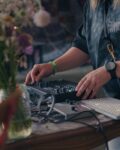
It’s a power station for me. I plug it in, and the sounds that come out are so authentic. This thing is real, that’s for sure. Even the presets are great. I’m deep into it, and I think it’s a tool I could do a whole LP with: you can be so creative with it.
I’m not the kind of musician that changes synths all the time, I stick to two or three synths and take everything out of it.
Do you like the aesthetics of it?
That’s what I wanted to say: it’s a massive thing, which I like. Most synthesizers are very light, which of course is not a problem, it’s an advantage when you travel with it, but this is a thing! You put it on the table, it’s there, there’s gravity to it.
Also, the aftertouch, oh my God, the aftertouch and the modulation, this is so amazing. I like it. I like it a lot.
What’s your synth loadout other than the Analog Keys?
An old Novation synth, the first one I ever got when I sold my stage piano to get money for a synth, a Korg MS-20 and an ARP Odyssey. I also use some nice plugins, and sample live drums and guitar when I need it, and that’s it. I never had a big studio, just a couple of synths.
When I need something else, I ask a friend to lend me perhaps a Juno or whatever.

The nuances are important when turning a good tune into a great one. What's your best recipe for getting the bass, kick and hi hat sound right?
I have no clue! Sometimes I work with sequencing, sometimes I pick up a couple of drumsticks. I just have very different approaches from one track to another. I guess all songs had this in common though: I gave each one a lot of time, as much as needed, attention and care.
Did you usually get it right the first time or did you change it up completely a couple of times?
Some stuff was really done in a couple of hours, other stuff like Die Dimension I needed to record again and again. I lost the project. My computer died, and the whole project died with it. The only thing left of the song was a single mp3 file, an early version of it.
It took one month to re-record everything, because I had to re-do all the settings on my old synthesizer, all the tunings, transpositions and modulations to get it to match the rest of the instruments again. It was an old, f**d-up synth but I needed that sound! Doing that again, doing all the other layers and then the mixing again was just terrible. I nearly gave up. Die Dimension was a tough part of the LP.
You got there, though, and it’s been setting the clubs on fire ever since its release!
I never, ever thought that someone would play it in a club (laughs)! I was so surprised, and with Alles, I was like: huh? They’re playing it in a club! Huge thanks to all those DJs who play it, Dixon and others! Sometimes it’s worth going deeper in the production of a song. Sometimes it’s just about catching the moment, like with PMS for example. That was really one of my darkest hours. Like, you know, PMS (laughs)? I was just playing around, I spent 24 hours in the studio, I was addicted! I think that explains a lot. With the drums, I have a knack for rhythm, I knew that, but I didn’t really care about if it was something fancy or not.
What sort of vibe do you prefer when you perform?
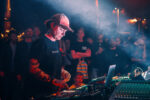
I’m all for the crazy, intense vibe. For me, playing music is a stress relief. I have my moments when I need to be alone, when I need to go outside into nature, or visit my parent’s place and not be in super crowded places, but when I play and when I’m on stage, I know that from my former experience in punk bands, I turn into another person (laughs) and I like that somehow! Just let everything out. You know, I also like to play warm-up music, I love every occasion when the punk side of me comes out! I love techno clubs that still have a punk attitude.
You can still find those, if you look hard enough?
Yes, I think so!
Do you remember the moment when you decided to go for a life in music?
Yes, that was the moment when I ended up in an unemployment office after my studies. I cried. I mean, I’ve been making music for as long as I can remember, but that was really the moment. Up to that point I had done exactly what my parents had wanted: went to school, studied, got my degrees, struggled to get that proper job with job security. I had no money after my studies, and I cried right there in the unemployment office because I knew I was going to have a tough time ahead of me.
Can you share a magical moment you've experienced?
When DFA wrote me that e-mail and said they wanted me to do an LP. I thought they were kidding! I didn’t believe it until I had this record in my hand. Really! It came as a complete surprise because I thought I knew all about DFA and that they didn’t do German music! I mean, what is German music, but more like: why me? I was already a big DFA fan. That was the one for me. The most remarkable moment. That was the moment when everything was worth it: the struggle, the crying, everything.
Are you from Berlin, originally?
No, I was born in rural Saxony in former East Germany. Near Dresden, but closer to the border to the Czech Republic. Meadows, hills, a few mountains, snow in the winter. It’s beautiful, but it’s problematic now because of the whole right-wing situation. Not cool. I had to leave to go study elsewhere, but now I’m trying to do some sort of event in a year or so to bring something back to the place I was born. Part of the problem is the people there think they are forgotten and nobody cares about them. People are leaving.
You see that a lot all over Europe now.
It’s not the only place with problems, but I think it’s one of the darkest places.
Do you remember anything from the day the wall came down?
No, I was too young! I started elementary school in the Nineties. The main thing I remember is when my older brother came home with all this Nutella. That was great (laughs)! I was too young to understand what was going on, though, I was four or five years old, so I don’t remember being that emotional about it.
Much later I began to understand what was going on, and the flipside of it is that a lot of people felt they lost their identity, it was a very polarizing situation. My parents were always liberal and embraced the new situation, and a lot of my relatives lived in the Western part of Germany and in Switzerland, so for us it was like a miracle.
Your success story is so inspiring. Do you have some words of advice for people who want to take the leap into music production?
I can only really share what worked out for me. You should only do music for yourself. Try to reach your innermost emotions and try to bring them as direct as possible into your music. So, just honesty, really. Be honest to yourself. When I started out, I thought I had to sound like something or someone else or do things in the style of what’s cool right now to be successful. I thought I had to fit in somehow.
It didn’t work out, and I got frustrated. At that point I just did the opposite. Do what you want and don’t give a s**t about real or imagined expectations. You have nothing to lose. That was how it started for me. You will always have super-successful artists doing music that is not personal at all, that sure works too, but I can’t talk about it because all I can honestly relate to is myself and how I make music.
Find out who you are and why you make music. Be honest to yourself. Never follow the current hypes. That doesn’t work. It’s an illusion.
Interview by Daniel Sterner
Photo by Nora Heinrich