/
Talk
Orbital
March 27, 2008
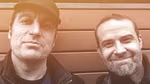
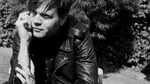
Ever heard of Orbital? Thought so! Paul Hartnoll and his brother Phil were a part of this hugely influential duo that helped shape a whole generation of electronic musicians. Recently he has gone solo, to much acclaim. We found this nice chap in his studio, occupied with an old friend of ours.
Hi there Paul, what are you up to?
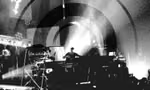
I’m in the studio and was actually just programming the Sidstation. I’m trying to come up with a lead line and I think it will be perfect for this.
When listening to your solo album The Ideal Condition I get these images in my head. Majestic camera sweeps over the green hills of England, vast mountains and things like that. A kind of filmic sound.
Yeah, I think it’s quite like that. I also feel it is quite English sounding. I love melancholic music, I don’t know why, but I guess that is what attracts me to film music as well. I really relish that kind of thing. I live in a seaside town and I love the winter here when it’s rainy and stormy and nobody’s on the streets. One of my favourite places is a big series of hills very close to where I live. I went there a lot when writing the album. You can see for miles up there and often when I felt creatively stuck I went there for a walk, watching the sun set. It’s so ancient. Untouched and unspoilt.
I was quite surprised hearing Robert Smith singing on one of the songs. How did that collaboration come about?
We did a festival in Sweden where the Cure also was playing. Robert peered into our tent holding a bottle of Pernod, I invited him for a drink and we got along really good. I thought he’d be the perfect person to get in touch with if ever the right sort of track should appear. Later on, when working on my album, I wanted someone with a rakish, bendy kind of voice and he immediately came to mind. I got in touch with him, asked him if he wanted to contribute and he said yes.
You have worked with commercials, movie scoring and game sound tracks. What differs between composing your own music compared to working for someone else?
Sometimes it’s easier making things for other people as you get this creative bondage. It’s almost like a musical game, like “can you do this in only one minute, using only these sounds?” I love that kind of thing. It’s bit like the science labs found on the Elektron users forum, where you are supposed to make a tune by using for example only one sound on the Machinedrum. Those limitations instantly open up your head to other possibilities. The more I work with films or adverts or video games, the more it brings to my own music.
When you’re in the studio, do you have a general approach to composition?
I used to go into the studio not knowing what to do. There were always major elements of experimentation, I sat down at something I liked the look of and saw what happened. Nowadays I try to focus, like, figuring out beforehand what synth is going to be best for the job. I do try to work fast though. I don’t want to be trapped into this studio deadlock where you just listen to the same thing over and over. If that happens I try to move forward or even stop working on that particular track.
How did the Elektron gear find their way into your setup?
The thing that really caught me with your stuff was the parameter locks. Every single note can be a new sound. I could use my computer to come up with similar things, using a lot of control information, but how tedious and boring that would be. The thing about the Monomachine and Machinedrum is their ability to instantly do this stuff. I also like to approach them without a plan. You just go with the vibe, press record and turn some knobs along with the rhythm. It creates these really odd yet natural sounds that you just wouldn’t come up with any other way. I don’t know any other gear that offers this.
A bit about your past then. When you were a part of Orbital you sampled Crass and Dead Kennedys – did their punk ethics inspire you?
Absolutely. It taught me not to follow rules. When I started doing dance music I felt the scene was constricted and stuck in a rut. You couldn’t do an acid house track and a soul like track under the same name. That was something we consciously wanted to avoid. Whatever we did, we put it out under the name Orbital. I wasn’t really politically active though, but I was a protester. I tried to promote pacifism when I was younger and I would go on demonstrations and things like that. When we were on the Top of the Pops in 1990 we wore Anti-Poll tax t-shirts.
You’ve been a part of the music scene for quite some time. What contemporary artists do you like?
Hm… What have I bought recently? I always keep an eye on Autechre and I really like the Tuss. It’s a bit like the Analord stuff, but a little snappier. I recently discovered the Knife, from your homepage actually. When reading the interview I thought, yeah, that sounds interesting. I’ve been sort of buying their back catalogue and I think they’re one of my favourite electronic bands at the moment. You have given me a love of the Knife.